
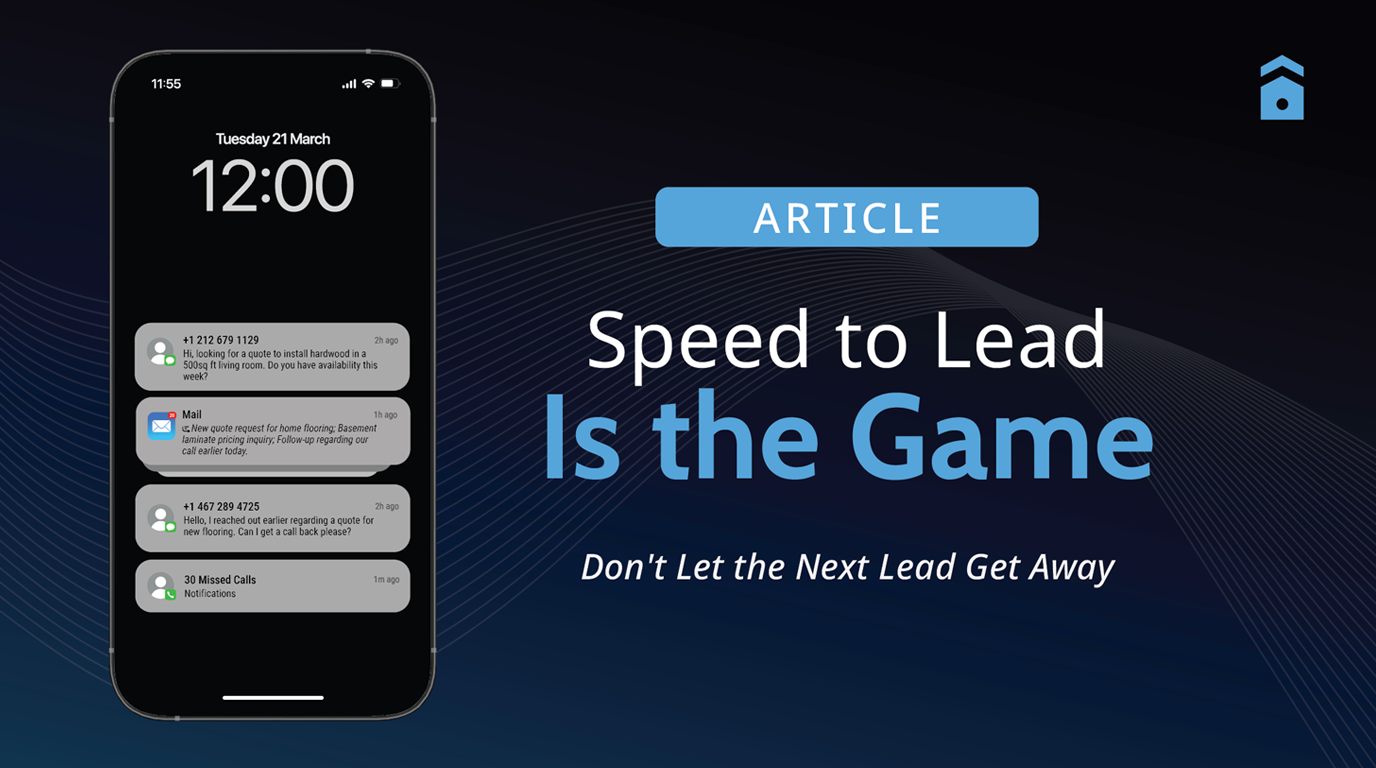
Every home services business has a lead that got away. Not because the price was wrong, or the service didn’t fit. It got away because someone else called back first.
That’s the part of the business that people rarely talk about in strategy meetings. Everyone wants to talk about lead volume, ad spend, and conversion funnels. Fewer people want to talk about the fifteen minutes right after a lead comes in, because that’s the window where you actually win or lose deals. Centah also built its entire platform around this exact window.
The Math Behind Speed to Lead
Here’s the number that should change how every contractor thinks about their intake process: setting an appointment the moment a lead comes in can increase closing rates by as much as 60%*.
Not 60% more leads. 60% more of the leads you already have turning into booked jobs.
Think about what that means in practical terms. If a business closes 20% of its leads today, getting to that lead immediately and locking in an appointment could push that closing rate well above 30%. Same ad spend. Same lead volume. Same team. You only changed a single variable: speed.
Centah’s analytics layer, built on Looker, makes that variable visible instead of theoretical. It gives a real-time view across the funnel and ties every closed dollar back to the campaign and contractor behind it, so a manager isn’t guessing where they are losing deals. They can see it directly.
Why Speed to Lead Matters More Than Almost Anything Else
A homeowner who fills out a form for a roof repair, an HVAC quote, or a plumbing job usually isn’t shopping around out of curiosity. Something broke, leaked, or became urgent enough that they stopped scrolling and typed in their information. That moment of intent doesn’t last.
The homeowner is likely filling out more than one form. Aggregator sites focus on comparison, so by the time a lead lands in an inbox, three or four other inboxes may already have it too. The business that responds first, and responds with a real appointment time rather than a vague “we’ll be in touch,” is the one the homeowner remembers as the provider who showed up.
Intent doesn’t cool over hours. It cools over minutes, while a homeowner still sits on the couch scrolling for the next option. Centah built its scheduling feature to close this exact gap. The system automatically pre-qualifies leads with all the information you need the moment they arrive, and the homeowner can self-schedule an appointment on the spot, no phone tag, no waiting for a callback.
Where Most Contractors Lose the Speed to Lead Race
Most home services businesses aren’t losing leads because they don’t want to respond fast. They lose them because of what happens behind the scenes when a lead comes in.
The office is on another call. The lead came in after hours. The technician who normally follows up is out on a job site with no time to check email. The form submission goes into a queue that nobody checks until the end of the day.
None of these situations point to a poorly run business. They point to a business that stays busy doing the work, which creates the exact problem. The teams best at installing a furnace or fixing a leak aren’t always the teams you build to drop everything and call a lead back in two minutes. You are dealing with two different skill sets, and trying to handle both well with the same small team causes speed to lead to break down.
Centah designed its geographic routing specifically for this failure point. The platform matches leads to the right contractor using driving distance, ZIP/postal code, and territory logic, so nothing waits on one busy person. If an unacknowledged lead sits too long, the platform catches and reroutes it to the next available contractor before the homeowner notices any delay.
What Changes When Someone Else Owns That First Call
For businesses that can’t staff a fast first response internally, a dedicated intake function changes the equation entirely. When calling and qualifying leads becomes someone’s full-time job instead of something they squeeze between service calls, response time drops from hours to minutes.
That gap matters more than it sounds: after 4 hours, appointment rates drop by 37%**. Centah’s Contact Center exists specifically to close that window for aggregator leads. The system logs every call straight back into the same records your own team uses, ensuring that nobody loses critical details during the handoff.
The Takeaway
Lead generation gets most of the attention because it’s visible. Marketers can easily measure and discuss ad campaigns, landing pages, and lead sources in a board meeting. But generating a lead is only half the job. What you do in the minutes after that lead comes in decides whether your marketing spend actually turns into revenue.
If there’s one process worth auditing this quarter, it’s not the ad creative or the landing page copy. It’s the stopwatch between “lead received” and “appointment booked.” Centah built its platform to shrink that stopwatch and show a business exactly where those minutes escape. For most home services businesses, real growth sits right there, waiting for someone to pick it up.
*Based on internal Centah Inc. research, 2025-2026.
**Based on internal Centah Inc. research, H1 2026.
