
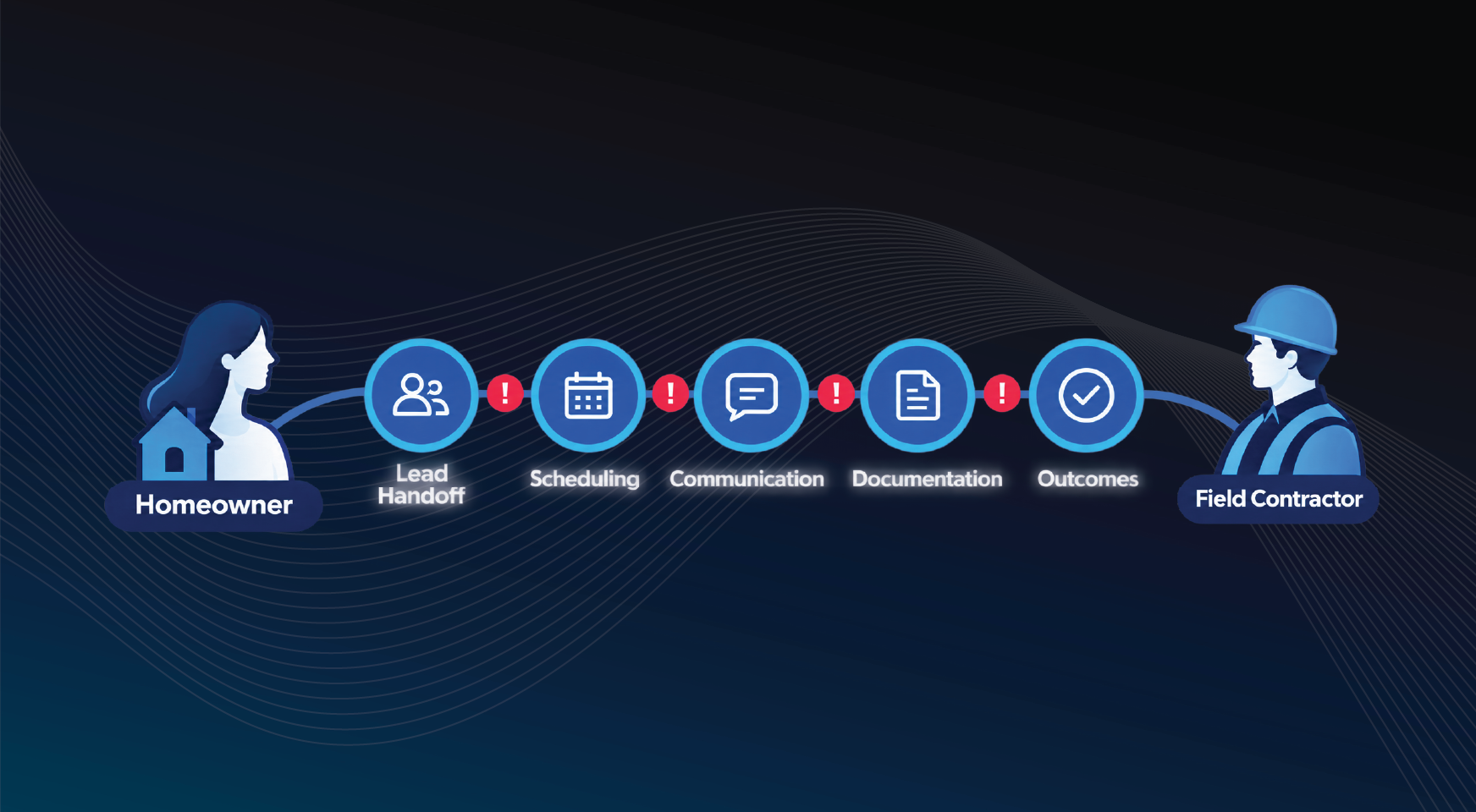
In a managed service network, the customer journey starts under one brand and finishes with another company. The homeowner chooses your name. An independent contractor then visits the home, quotes the job and does the work.
That model lets you scale without employing every installer. However, it also creates a gap. You carry the brand promise, yet the contractor controls most of what the homeowner experiences.
As a result, many networks can describe the first step in detail and the rest only in outline. This article looks at where control slips, what it costs and how to keep it.
Where Control Slips: Five Handoffs
Control is rarely lost all at once. Instead, it slips at each handoff between the network and the contractor.
- The lead handoff: The lead leaves your system by email, spreadsheet or portal. After that, you cannot see whether anyone called the homeowner, or how quickly.
- Scheduling: The appointment sits on the contractor’s calendar, not yours. Therefore, when a homeowner calls you to ask when someone is coming, your team has no answer.
- Communication: Each contractor contacts the homeowner in a different way, from a different number, with a different tone. Consequently, the experience under your brand changes from one postal code to the next.
- Documentation: Licences and insurance expire. If you track them by hand, a lead can reach a contractor who is no longer cleared to do the work.
- Outcomes: The quote, the sale and the completed job are recorded in the contractor’s own tools. So the data you need to judge the program never comes back to you.
What Losing the Customer Journey Costs You
The first cost is to your brand. A homeowner does not separate the network from the contractor. If the contractor is late, silent or careless, the complaint carries your name.
The second cost is revenue. Leads that are never contacted do not convert, and you are paid to generate every one of them. Moreover, without outcome data you cannot tell which contractors close and which let leads go cold.
The third cost is risk. A job completed by a contractor with lapsed insurance is a liability you did not agree to carry.
Finally, there is the cost to your contractors. Strong partners want fair lead distribution and clear expectations. When the process is opaque, your best contractors lose patience first.
How to Keep Control Without Doing the Work Yourself
You do not need to employ the contractors to own the experience. You need one shared system that follows the lead from first contact to completed job.
- Keep the lead in one place: In Centah, the lead is routed to the contractor inside the platform. Because it never leaves, you see every status change as it happens.
- Make the calendar visible: Appointments are booked against contractor availability in Centah. As a result, your team can answer the homeowner’s question the first time.
- Set one standard for communication: Centah Contact Center gives the homeowner one consistent voice by call, SMS and email. Its North American agents work 24/7, 363 days a year, so the first response does not depend on each contractor’s office hours.
- Automate licensing: Automated Credential Manager tracks licences and insurance for every contractor in your network. Therefore, leads only go to partners who are cleared for the job.
- Bring the outcome back: Quotes, sales and completions are recorded on the same lead. In turn, you can compare contractors on results and not on volume alone.
Own the Experience, Not Only the Brand
A managed service network is judged on work it does not perform. That will not change. What can change is how much of the customer journey you can see and shape.
So start with the handoff that hurts most today. Close that gap, then move to the next. Each one you close makes the experience under your brand more consistent, and your program easier to grow.
Book a demo to see how Centah keeps the full customer journey in view, from first contact to completed job.
