
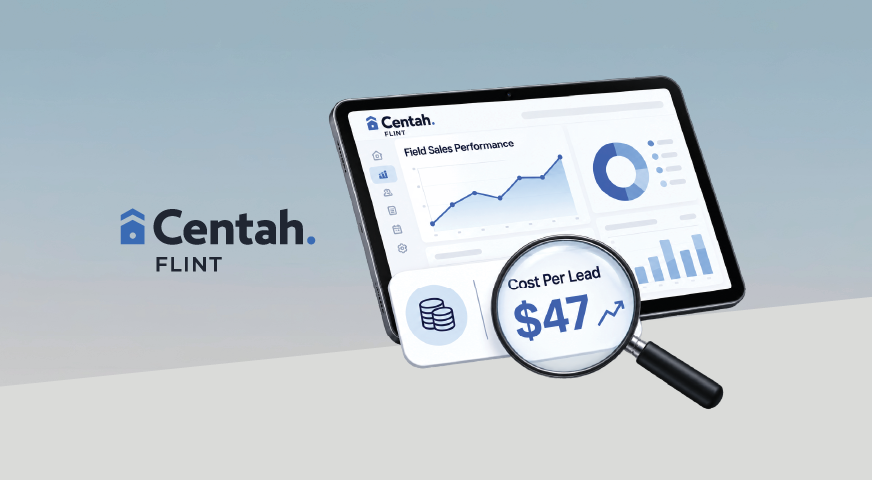
Ask a home services marketer for the cost per lead on a search campaign and you will get an answer in seconds. Ask the same question about last weekend’s home show and you will get a guess.
That gap is the blind spot. Digital channels are measured to the click. Field channels, by contrast, still run on timesheets, receipts and instinct. Yet for many home services businesses, the field is where the best leads come from.
Our view is simple. A channel you cannot measure is a channel you cannot manage. Therefore, field teams deserve the same discipline that paid media has had for years, and it starts with one input most teams never capture properly: rep hours.
Rep hours are the largest hidden cost
When teams budget for field marketing, they count what arrives as an invoice. Booth fees, store placement, signage and travel all make the list. Labour often does not, because it sits in payroll and not in the marketing budget.
However, labour is usually the largest cost of any field program. Every hour a rep spends at an event, in a store or on a warehouse floor is money spent on lead generation. If those hours are not tied to the leads they produced, your true cost stays hidden.
The usual tools make this worse. Paper timesheets record that a rep worked a shift. They do not record where, for which campaign, or what came of it. As a result, two reps can cost the same and deliver very different returns, and nobody sees it.
How to calculate cost per lead for a field team
The formula itself is not complicated. Add the cost of your rep hours to the direct costs of the activity, then divide by the leads it produced.
Cost per lead = (rep hours x hourly cost + direct event costs) / leads captured
The difficulty is in the inputs. To trust the result, you need three things recorded at the source:
- Hours by rep and by location: Not a weekly total, but the hours worked at each event, store or shift.
- Leads by rep and by source: Each lead tied to the person who captured it and the campaign that paid for it.
- Outcomes: Whether the lead booked an appointment, so you can separate volume from value.
If any one of these lives on paper or in a separate spreadsheet, the calculation breaks. Someone has to match timesheets to lead lists by hand, and that work rarely gets done.
How Centah Flint tracks field rep hours
Centah Flint is a lead generation app for field reps. It records all three inputs in the same place, at the moment they happen.
- Clock in and clock out: Reps start and end each shift in the app. Because the same app captures their leads, hours and results are linked from the first minute.
- Marketing source on every lead: Each lead carries the source that produced it. Consequently, you can compare a home show with an in-store program on equal terms.
- Appointments booked in the field: Reps book from real-time Centah availability, so the outcome is recorded alongside the lead.
- The Lead Volume Dashboard: You see lead volume by rep, event and location without building a report. In other words, the numbers you need for the formula are already together.
What changes when you know your cost per lead
A number on its own does nothing. The value is in the decisions it makes possible.
- You choose events based on evidence: Instead of returning to a show because you always have, you compare what each one cost against what it produced. Some of your busiest events will turn out to be your most expensive.
- You staff with purpose: When hours and leads sit side by side, you can see whether a third rep on a shift added leads or only added cost.
- You coach the right people: A rep with fewer leads and more booked appointments may be your strongest performer. Without outcomes in the picture, that rep looks average.
- You speak the same language as the rest of marketing: Once the field has a cost per lead, it can be weighed against paid search, paid social and referrals. For the first time, the budget moves between channels on a like-for-like basis.
There is a further step. Cost per lead tells you what you paid for a name. Cost per booked appointment tells you what you paid for a real opportunity. The teams that lead this industry will manage to the second number, because the list is not the win. The booked calendar is.
Measure the field like any other channel
Field marketing has been run on trust for a long time. That was reasonable when the only tools were a clipboard and a timesheet. It is harder to defend now.
So start with one program. Track rep hours and leads in the same place, and work out your cost per lead for a single month. Then ask which events, shifts and reps you would fund again.
Contact us for a free demo of Centah Flint and put a real number on your field program.
