
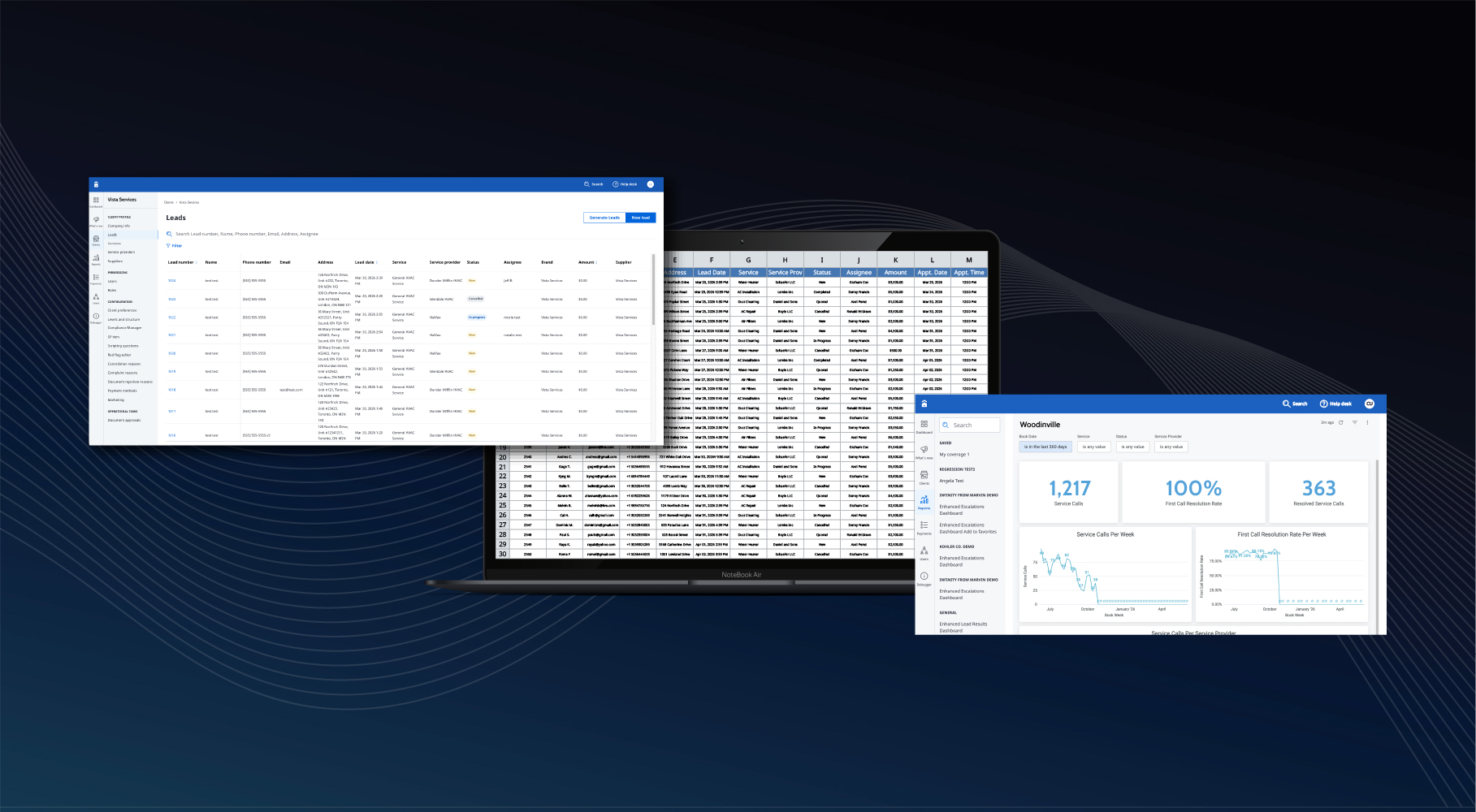
Spreadsheets are where almost every home services business starts, but relying on manual tracking quickly reveals why growing companies need dedicated software. Spreadsheets are familiar, flexible, and free. But the same qualities that make them useful in the early days are the exact reason they start working against you as your business grows.
If you are still tracking leads, jobs, and contractor performance in Excel or Google Sheets, here are five signs it might be time to adopt specialized home services software built specifically for the job, and the Centah CRM platform features that solve each one.
1. Leads are falling through the cracks
A spreadsheet has no idea when a new lead comes in. It cannot tell you which contractor is actually available in that service area, and it will not notice when a request sits unacknowledged for hours. That job falls entirely on whoever remembers to check the sheet.
Centah’s home services software features Omnichannel Lead Capture pulls every inquiry, whether it arrives through an API, a web form, or a mobile canvassing app, into one system the moment it comes in. From there, Geographic Lead Routing connects each lead to the right provider using driving distance, ZIP/ postal code, county lines, and custom radius maps, and automatically reroutes anything left unacknowledged so nothing sits waiting for someone to notice.
2. You cannot answer basic questions about your pipeline without a manual pull
Ask yourself: which of your partners is converting best right now? Which campaign is actually driving completed jobs? If answering either question means opening a spreadsheet and building a pivot table, your reporting has not kept pace with your business.
Our Analytics & Marketing Attribution feature, powered by Looker, gives you live dashboards across every stage of your funnel and ties every completed dollar back to the specific campaign that generated it. Instead of static, backward-looking reports, you get real-time insight into where to double down and where opportunity is being left on the table.
3. You have no real visibility into your contractor network
As your network of partners grows, a spreadsheet cannot tell you who is underperforming, who has coverage gaps, or who needs to be paused. That kind of oversight requires someone manually cross-referencing data, and it rarely happens consistently.
The Enterprise Network Orchestration feature in Centah centralizes your entire contractor ecosystem into a single hub, mapping service areas to close coverage blind spots and giving you one-click control to pause leads or place underperforming partners on probation. Real-time data surfaces your top performers automatically, protecting your brand instead of leaving it to guesswork.
4. Booking a job depends on phone tag, not process
In a spreadsheet-based system, scheduling usually means a back-and-forth phone call, a note jotted in a margin, and a hope that someone follows up. There is no consistency from one team member to the next, and every delay is a chance for the customer to shop around.
Centah’s Zero-Friction Scheduling syncs directly with your team’s existing calendars and lets customers self-schedule the moment they submit a lead, removing the manual booking friction that slows deals down and protects your closing rates in the process.
5. Growth is creating more admin work instead of more revenue
If every new partner, every new region, or every new compliance requirement means more manual spreadsheet work rather than more predictable revenue, your systems are working against your growth instead of supporting it.
The Centah Turnkey Integration Engine connects your network’s patchwork of software through modern APIs and webhooks, eliminating duplicate data entry as you scale. Automated Credential Manager replaces manual license and insurance tracking with automatic expiry alerts and self-serve management, so growth never means accidentally dispatching an uncertified provider. And Centah’s Mobile Field Platform puts the entire sales cycle in your team’s hands, letting contractors quote, close, and update jobs in real time from the customer’s location instead of making a trip back to the office.
Making the switch to modern home services software
None of this means spreadsheets were a bad choice when you started. They almost always are the right tool at the beginning. But if two or more of these signs sound familiar, it is worth asking whether your current system is helping your business grow, or quietly holding it back.
Centah was built for home services businesses that have outgrown manual lead tracking and are ready for a system that captures leads, automates follow-up, and gives you clear visibility into your pipeline, all in one place.
Ready to see how this works for your team? Book a demo with Centah today!
